Last updated: October 16, 2026
The Flock camera map most people are looking for is DeFlock, a crowdsourced project that plots automated license plate readers, or ALPRs, on OpenStreetMap. It shows you where the cameras are. It does not show you who pays for them. Across 53 Flock Safety contracts recorded in 2025 and 2026, 48 US agencies paid a median of $36,000, from $3,000 to $8,471,760. Another 17 jurisdictions, in 11 states, moved to cancel or not renew.
Quick Answer
- The map is at deflock.org. It is crowdsourced, built on OpenStreetMap, and it is not run by Flock.
- Median Flock contract in the records: $36,000. Half of the 53 contracts fall between $18,000 and $76,915.
- The biggest single award recorded is $8,471,760 in Boynton Beach, Florida. The smallest is $3,000.
- Seventeen jurisdictions across 11 states show cancellation, non-renewal or rejection activity in the records.
- The widely quoted “32.3% false positive rate” is from an audit covering three vendors, not Flock alone. Details below.
Where the Flock cameras are: the map
DeFlock is the map. It was started in October 2024 by Will Freeman, a software engineer, and it runs on OpenStreetMap, which means volunteers add the cameras. It records where a reader is and which way it points.
Credit where it belongs: this is a volunteer project, and the data is theirs. Nothing in this article reproduces their map. What follows adds the layer they do not have, which is who signed the contract and what it cost.
How to find Flock camera locations near you
Open deflock.org and zoom to your town. Cameras appear as pins, usually with the direction the reader faces. Coverage depends entirely on whether someone in your area has walked or driven the streets and submitted them.
That is the honest limit, and it is worth saying plainly. A blank area on the map means nobody has mapped it. It does not mean there are no cameras.
What the map does and does not show
It shows locations that volunteers found and logged. It does not show four things a resident usually wants to know.
- Which agency operates the camera, as opposed to which city it sits in.
- What the contract cost, or whether the city or a grant paid.
- When the contract expires and whether it auto-renews.
- Whether the camera is still active. A cancelled contract does not remove a pin.
Those four are the gap this article fills, from contract records rather than from field observation.
How many cameras are mapped
Published counts differ a lot, and that is worth knowing before you quote one. Figures in circulation for 2026 range from about 90,000 to more than 300,000, depending on whether the count covers the United States or the world, and whether it counts only Flock or all ALPR brands.
One dated figure is usable. As of August 9, 2026, OpenStreetMap held 138,351 features tagged as ALPR worldwide, of which 127,878 were in the United States, spanning Flock and other vendors. That count rises weekly as volunteers add entries, so treat any number you see as a snapshot with a date on it, including that one.
What a Flock camera looks like
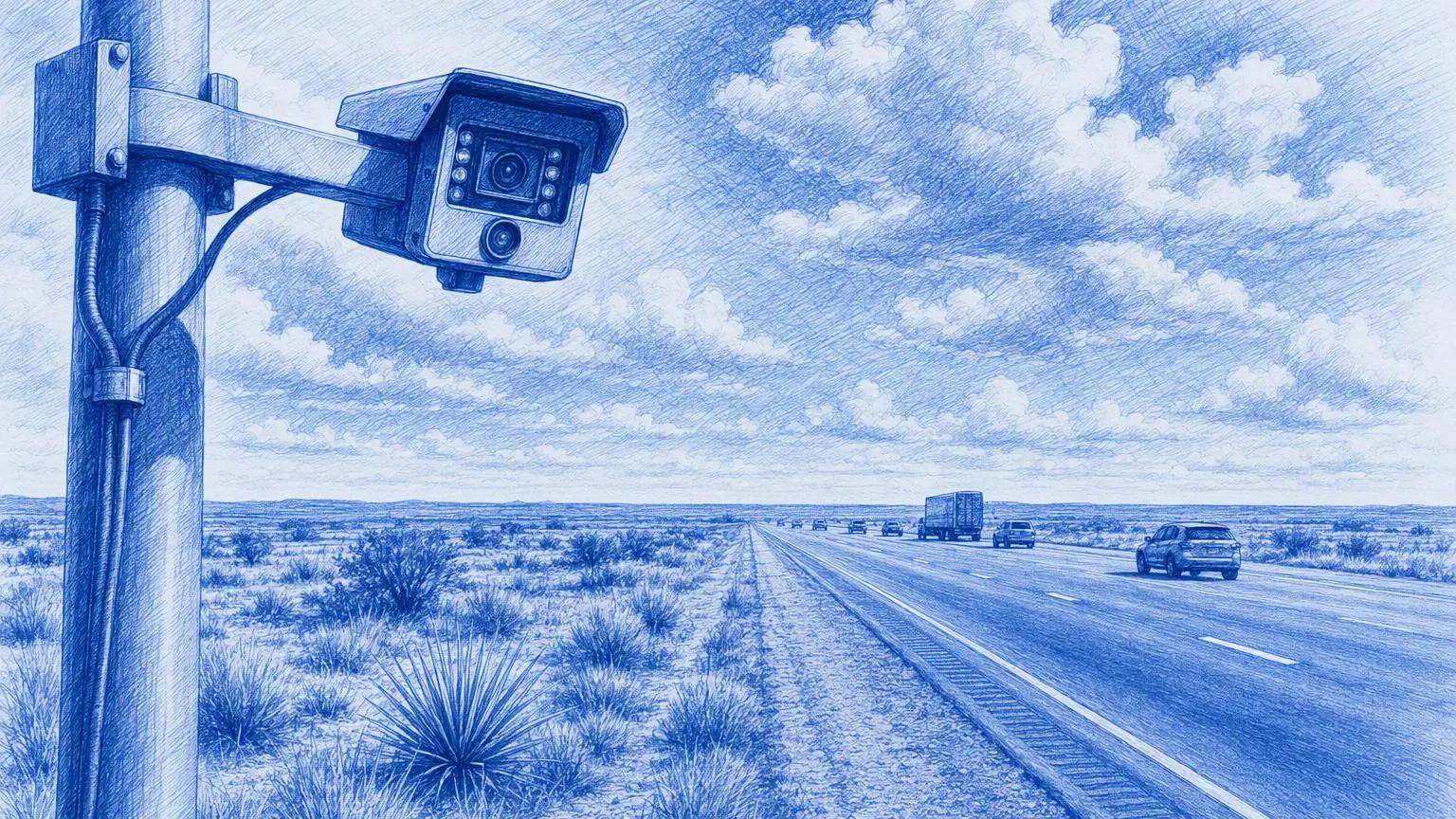
A small rectangular camera head on a slim pole. There is often a solar panel and a battery box strapped below it. Most sit eight to twelve feet up, facing a traffic lane rather than a footpath. Many stand on their own pole rather than on existing street furniture. That is what makes them noticeable.
The solar panel is the usual giveaway. One small camera and one panel on a dedicated pole, watching a road, is the standard install. But Flock is not the only ALPR supplier. Sight alone will not tell you the brand. The contract record is how you confirm which vendor a city uses.
What cities actually pay for Flock cameras
The median Flock contract in the records is $36,000. That covers 53 contracts across 48 agencies in 23 states, recorded in 2025 and 2026. A quarter came in under $18,000. A quarter ran over $76,915.
| Contract size | Contracts | Median | Range |
|---|---|---|---|
| Under $25,000 | 20 | $12,975 | $3,000 to $24,500 |
| $25,000 to $74,999 | 18 | $39,482 | $25,000 to $74,000 |
| $75,000 to $249,999 | 8 | $122,250 | $75,000 to $249,777 |
| $250,000 and above | 7 | $384,000 | $283,400 to $8,471,760 |
Source: Civic IQ contract records, council agendas and budget documents, 2025 and 2026. 53 contracts where Flock is the named subject of the award, with a stated value and a named agency. Bundled public-safety budget lines where Flock’s share cannot be separated were excluded.
What a full city contract runs
Named awards, largest to smallest.
| Agency | What was recorded | Value |
|---|---|---|
| Boynton Beach, Florida | Flock Safe City Initiative, sole source agreement | $8,471,760 |
| El Mirage, Arizona | Flock integrated public safety platform | $1,105,265 |
| Berkeley, California | Automated licence plate reader network renewal | $660,000 |
| Springfield, Illinois | Flock Safety ALPR system funding for the police department | $508,000 |
| North Richland Hills, Texas | Renewal of Flock gunshot detection and cameras | $384,000 |
| Livonia, Michigan | Flock Safety ALPR camera system deployment | $295,350 |
| Yakima, Washington | Flock Safety ALPR annual subscription renewal | $249,777 |
| Wichita, Kansas | Flock Safety LPR products contract extension | $75,000 |
| Genesee County, Michigan | Flock camera renewal, hardware and services | $60,000 |
| Hamtramck, Michigan | Flock Safety ALPR camera subscription | $53,750 |
Source: Civic IQ contract records, 2025 to 2026. Values as stated in the awarding or budget document.
The spread is the story. Boynton Beach, Florida and Hamtramck, Michigan both bought Flock cameras. One record shows $8,471,760, the other $53,750. That is a 158 times difference, and it is not explained by city size alone. It reflects how many cameras, whether gunshot detection and other modules are bundled in, and whether the figure covers one year or a multi-year programme.
This is why a single “what does a Flock camera cost” number is misleading, and why most pages on this subject avoid the question. The useful comparison is a city of roughly your size, in the same year, buying roughly the same modules.
Flock against the other plate readers
Flock is the name people know, but it is not the only ALPR vendor a city can buy. Motorola and Axon both sell into the same budget line, and the records show cities running more than one at once.
Three examples make the point. Benton County, Washington recorded an Axon ALPR camera system replacement at $227,107. North Salt Lake in Utah recorded ALPR camera and software services covering both Flock Safety and Motorola in one $51,000 item. Mill Valley in California recorded a police technology modernisation naming Flock and Axon together at $289,106.
That last pattern matters if you are comparing prices between towns. A figure labelled as a camera contract may cover two vendors, or cover body cameras and evidence storage alongside the plate readers. It is another reason a single national average for “a Flock camera” does not survive contact with the records.
For how these vendors differ on features and terms rather than on price, see our full comparison of ALPR vendors.
How it varies by state
Where you live changes the answer more than you would expect. These are the states with at least two recorded contracts.
| State | Contracts | Median | Range | Cancellation records |
|---|---|---|---|---|
| Texas | 5 | $40,560 | $8,000 to $384,000 | 5 |
| California | 4 | $72,750 | $36,000 to $302,500 | 1 |
| Michigan | 4 | $56,875 | $30,000 to $295,350 | 2 |
| Illinois | 4 | $67,975 | $6,000 to $508,000 | 1 |
| Missouri | 5 | $18,000 | $9,000 to $51,000 | 0 |
| Kansas | 4 | $23,750 | $12,000 to $75,000 | 1 |
| Georgia | 3 | $36,000 | $15,000 to $69,500 | 0 |
| Kentucky | 3 | $20,000 | $6,650 to $26,600 | 0 |
| Nevada | 2 | $99,708 | $76,915 to $122,500 | 0 |
| Florida | 2 | – | $52,000 to $8,471,760 | 1 |
Source: Civic IQ contract records, 2025 to 2026. Cancellation records counts the jurisdictions in that state showing cancellation, non-renewal or rejection activity. Florida has only two contracts and they sit far apart, so no median is shown.
Texas is the clearest case. It has five recorded contracts and five jurisdictions in the cancellation column, more than any other state on both counts. Adoption and reversal are happening in the same places, often in neighbouring towns.
Missouri and Kentucky sit at the cheap end, with medians of $18,000 and $20,000. California and Nevada run three to five times higher. Nine more states appear once each, which is too thin to publish a median for, and they are left out of the table rather than dressed up.
Texas has its own page. See Flock cameras in Texas, with the mapped reader count, the five contracts and the five jurisdictions that moved to end theirs.
Look up your own city
Every agency named in this article links to its own record, which lists what that agency has bought and from whom. The Flock Safety vendor record collects awards across agencies in one place. If your city is not in the tables above, search it there rather than assuming the absence means anything.
What is in a Flock contract besides the cameras
Several of these contracts are not only licence plate readers, which is a common source of confusion when residents compare figures between towns.
- Gunshot detection. North Richland Hills recorded a renewal covering gunshot detection and cameras together at $384,000.
- Platform and software modules. El Mirage recorded an “integrated public safety platform” rather than cameras alone, at $1,105,265.
- Subscription, not purchase. Most of these are annual subscriptions. The city does not own the hardware, which matters at cancellation.
- Grant funding. Several records tie the purchase to a public safety grant, which means the renewal cost lands on the city once the grant ends.
For how the market compares outside one vendor, see our analysis of alternatives and competitors in the ALPR market.
Why cities are cancelling Flock contracts
Seventeen jurisdictions across 11 states appear in the records cancelling, declining to renew, or rejecting a Flock proposal. The recorded reasons are consistent. Data sharing. Privacy review. And in several cases a council deciding the renewal was not worth the argument.
| Jurisdiction | What the record shows | Recorded |
|---|---|---|
| Sheboygan, Wisconsin | Citywide Flock Safety contract termination | Sep 2026 |
| Winnsboro, Texas | Flock Safety non-renewal notice | Sep 2026 |
| Quincy, Massachusetts | Flock ALPR privacy review and hearing | Sep 2026 |
| St. Paul, Minnesota | Flock Safety contract termination call | Aug 2026 |
| Oconee County, South Carolina | Flock camera contract termination dispute | Aug 2026 |
| Lago Vista, Texas | Flock Safety camera contract cancelled | Aug 2026 |
| Aransas Pass, Texas | Flock LPR system termination | Jul 2026 |
| Jasper County, Iowa | Flock cameras proposal declined | Jun 2026 |
| Pasadena, California | Evaluation and potential replacement of the Flock ALPR system | May 2026 |
Source: Civic IQ records, 2025 to 2026. Seventeen named jurisdictions in total across 11 states; nine shown.

Outside trackers are counting the same wave from news coverage. Finding Flock lists 14 verified cancellations and carries exactly one contract value. The difference is method. A clippings tracker records that a city cancelled. The procurement record shows what that contract was worth and when it was due to renew.
What the LAPD audit actually found
This is the most misquoted fact on this subject, so it is worth setting out carefully.
You will see it reported that Flock cameras have a 32.3 percent false positive rate. The source is an audit by the Los Angeles Police Department Inspector General, covering August and September 2025. The figure is real. The attribution is not.
404 Media, which read the report reports that the audit examined three different ALPR systems. Pole-mounted cameras from Motorola and from Flock. And in-cruiser cameras made by Axon. It was not a Flock audit. The 32.3 percent figure cannot be pinned on one vendor from it.
The denominator moves too. Those 161 bad alerts give 32.3 percent when set against the 498 alerts officers acknowledged. Set against the 5,911 plates the audit tracked, the same 161 is about 2.7 percent. Both numbers describe one audit.
For a buyer, neither percentage is the point. The report blamed inaccurate or outdated information. It blamed plates staying on a hot list after a stolen vehicle had been recovered, or reported as not stolen. That is a data problem in the records the system checks against. It is not the camera failing to read a plate.
So that is the question to ask if you are evaluating this. Who maintains the hot list? How fast are recovered vehicles removed? And who is accountable when a stale entry produces a stop? Los Angeles let its Flock contract expire after the audit.
What happens to the cameras after a cancellation
Most of these contracts are subscriptions, not purchases. The city does not own the hardware. Ending the contract means the service stops and the kit comes down. Removal is a small separate cost, and councils routinely forget to budget for it.

One practical note for anyone reading a map. A cancelled contract does not delete a pin. A camera shown on a crowdsourced map may have been switched off months ago.
Is it legal, and what are your rights?
Licence plate readers are legal in most of the United States. They are also regulated more every year, at state and city level. What a resident can actually obtain varies a lot.
Can the public see Flock camera footage?
Generally no, not the live feed. Police departments run these systems. Access is limited to authorised users. The paperwork is often public though. That means the contract, the council vote, the department use policy, and in some places an audit log of searches.
Public records requests for ALPR data
You can usually get the contract and the use policy through a public records request to the city or county. The plate reads themselves are normally exempt as investigative material. Several states also set rules on how long that data may be kept.
Start with the procurement record, not the data. It tells you the vendor, the camera count, the cost and the expiry date. It is also far easier to get.
State law and active litigation
A growing number of states now regulate ALPR use directly. Cities have added their own rules too, several requiring a public hearing before surveillance technology is approved. Court cases are live in several places over whether sustained plate tracking counts as a search. This is moving fast and differs by state. Check your own state code and city ordinance, not a national summary, including this one.
Open camera and reader bids
Live bids surfaced by Civic IQ. Status changes daily.
- Fixed Location Plate Readers, Fort Collins
- Security Camera Replacement, City of Anna
- School Zone Speed Cameras, Kissimmee
- Body Worn Camera System, Benton
Frequently asked questions
Why are cities canceling Flock cameras?
Seventeen jurisdictions across 11 states appear in the records cancelling, not renewing, or rejecting Flock. The recorded reasons are data sharing, privacy review, and cost at renewal. Texas accounts for five of the seventeen. Most surfaced at a renewal date or a study session, not mid-contract.
Can the public see Flock cameras?
You can see where volunteers have mapped them, at deflock.org. You cannot see the live feed. That is limited to authorised police users. The contract, the council vote and the department use policy are usually public records you can request.
Can I get access to Flock camera data?
Almost certainly not the plate reads. Those are normally exempt as investigative records. The paperwork is a different matter. The contract, cost, camera count and expiry date are usually obtainable, and they answer most of what people want to know.
How to spot a Flock camera?
Look for a small camera head on its own slim pole, about eight to twelve feet up. There is usually a solar panel and a battery box below it, and it points at a traffic lane. The solar panel on a dedicated pole is the giveaway. Other vendors use similar kit, so sight alone is not proof.
How much does a Flock camera cost?
Across 53 contracts recorded in 2025 and 2026, the median was $36,000. Half fell between $18,000 and $76,915. The full range runs from $3,000 to $8,471,760. Some records cover a handful of cameras. Others cover a citywide programme with gunshot detection bundled in.
Does the Flock camera map show cameras that were cancelled?
Not reliably. The map records what volunteers found on the street. A contract that ended does not remove a pin, and a camera taken down can stay on the map for months. For whether a system is still running, the contract record is the better source.
Related reading: our analysis of Flock alternatives and ALPR competitors, Flock government contracts and market position, what agencies paid for facial recognition software, and what US cities actually bought in smart city technology.
Contract figures come from individual records surfaced by Civic IQ from council agendas, purchase orders and budget documents, pulled September 13, 2026. The camera map is the work of DeFlock, a volunteer project founded by Will Freeman; this article does not reproduce it. Civic IQ tracks 100,000+ agencies, $14T+ in tracked spend, 1.5M+ documents per month, all 50 states.